How Non-Technical People Win In An AI-Native World
Read Time: 7 Minutes
You’ve heard AI is changing everything. Maybe you’ve played with ChatGPT a few times. Drafted an email. Closed the tab.
But you haven’t really changed how you work. And you’re not sure where to start.
This is the piece I wrote for you. Not for developers. For the person sitting at a desk, doing knowledge work, sensing that something big is shifting but not sure what to do about it.
Here’s what I keep seeing. The roles aren’t going away. Companies are still hiring product managers, marketing leads, financial analysts.
But they’re hiring directors, not doers.
The person who directs AI to build the analysis is replacing the person who builds it by hand. The person who uses AI to produce the marketing brief in 20 minutes is replacing the person who spends three days on it.
If your core value at work is creating output generated by computers (reports, decks, analyses, collateral), that value is shifting. Fast.
The heat window
The next 6 to 12 months will matter disproportionately.
The advantage is compounding for the people already in motion. Every month they build a new workflow, automate another task, push the tools further.
Dario Amodei is the CEO of Anthropic, the company that makes Claude. Last month he told Axios that AI could wipe out half of all entry-level white-collar jobs and push unemployment to 10-20% in the next one to five years.
He specifically named consultants, lawyers, and financial professionals.
Kevin Weil, VP of Product at OpenAI, said something I keep coming back to.
“This is the worst the models will ever be.”
Whatever AI does today is the floor. Not the ceiling.
Software developers got hit first. Tools like Cursor, Codex, and Claude Code transformed how they work. Many aren’t writing code anymore. They’re directing it. Shipping ten times faster.
That happened in under a year. Non-technical knowledge workers are next.
Output-creating roles (product, marketing, finance) are directly in the path. If AI can produce 80% of your deliverable in 10% of the time, the math on your role changes overnight.
People-oriented roles (sales, BD, venture, investment banking) are less directly impacted. AI won’t close a deal for you or build trust with an LP over dinner. But the person in your role who uses AI to research prospects and follow up faster will outperform you. The threat isn’t replacement. It’s being outcompeted.
Why most people can’t see it
You might read all of that and think, sure, AI matters, but I’ll get to it eventually.
I’d believe you if the environment were set up for that. For most people, it’s not.
Their companies block the tools. IT hasn’t approved ChatGPT. Legal is reviewing policies from two years ago. So while some people are building workflows, others are refreshing the same spreadsheets they’ve been using since 2023.
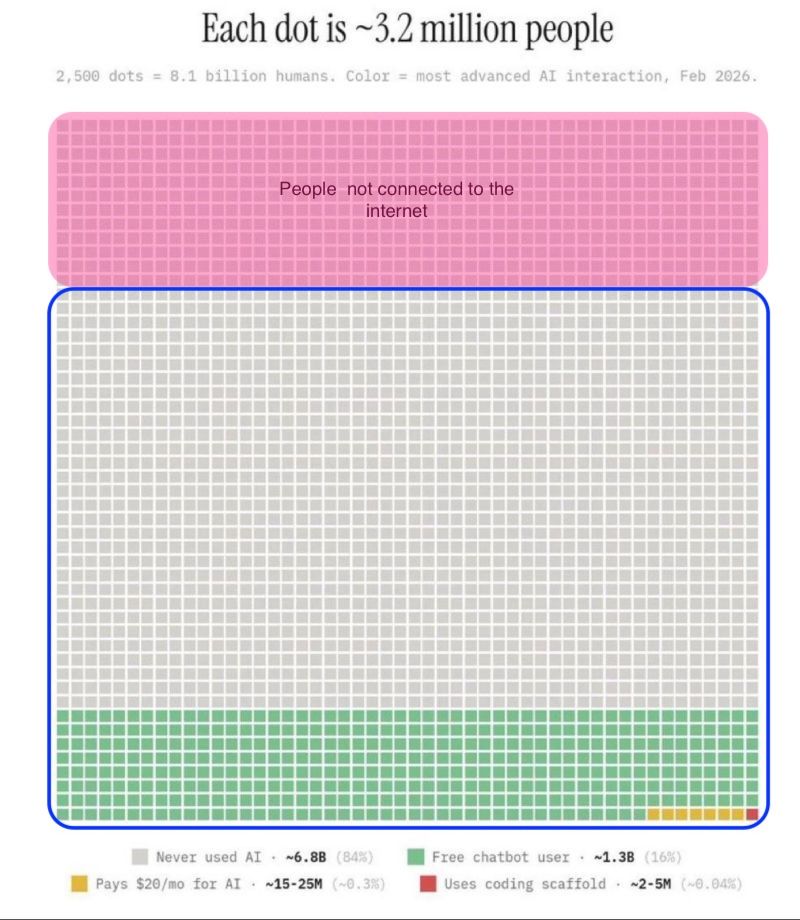 Each dot is ~3.2 million people. 84% of the world’s population has never used AI. Only 0.3% pay for it. The echo chamber makes it feel like everyone is using these tools. The data says otherwise.
I have friends at big tech companies who don’t even think this way. Their employers lock the tools down. Either way, the result is the same. They’re not getting the reps.
And when companies decide the math no longer works, they move fast. Jack Dorsey laid off most of Block’s engineering team last year. A $40 billion company. The roles weren’t underperforming. They were replaceable.
The agency gap
The exposure problem is only half the story. The deeper issue is agency and critical thinking.
A disproportionate gap is forming between people who have these meta-skills and people who don’t. The ability to see a problem, frame it as a goal, and build toward a solution without waiting for someone to hand you instructions.
That gap matters more than whether you know how to write a good prompt.
Dan Koe wrote something that reframed how I think about this. Your goals shape your perception, which shapes what you learn, which shapes your behavior.
My goal was “stop wasting 45 minutes on Friday dinners.” That single goal made me learn plan mode, build an agent, and automate eight more workflows after it.
“I should learn AI” never works because it’s goalless. You scroll, watch a demo, feel inspired for ten minutes, then nothing changes.
Agency and critical thinking are what separate directors from doers. The person with agency sees a bottleneck and builds a workflow. The person without agency waits for their manager to tell them what tool to use.
That’s why the Three Levels matter. They’re not about how much you know about AI. They’re about building the agency to direct it.
AI doesn’t replace anybody. It only replaces those who don’t direct it.
The Three Levels
Three levels. Each one builds agency and critical thinking. Each one expands the scope of what you can influence.
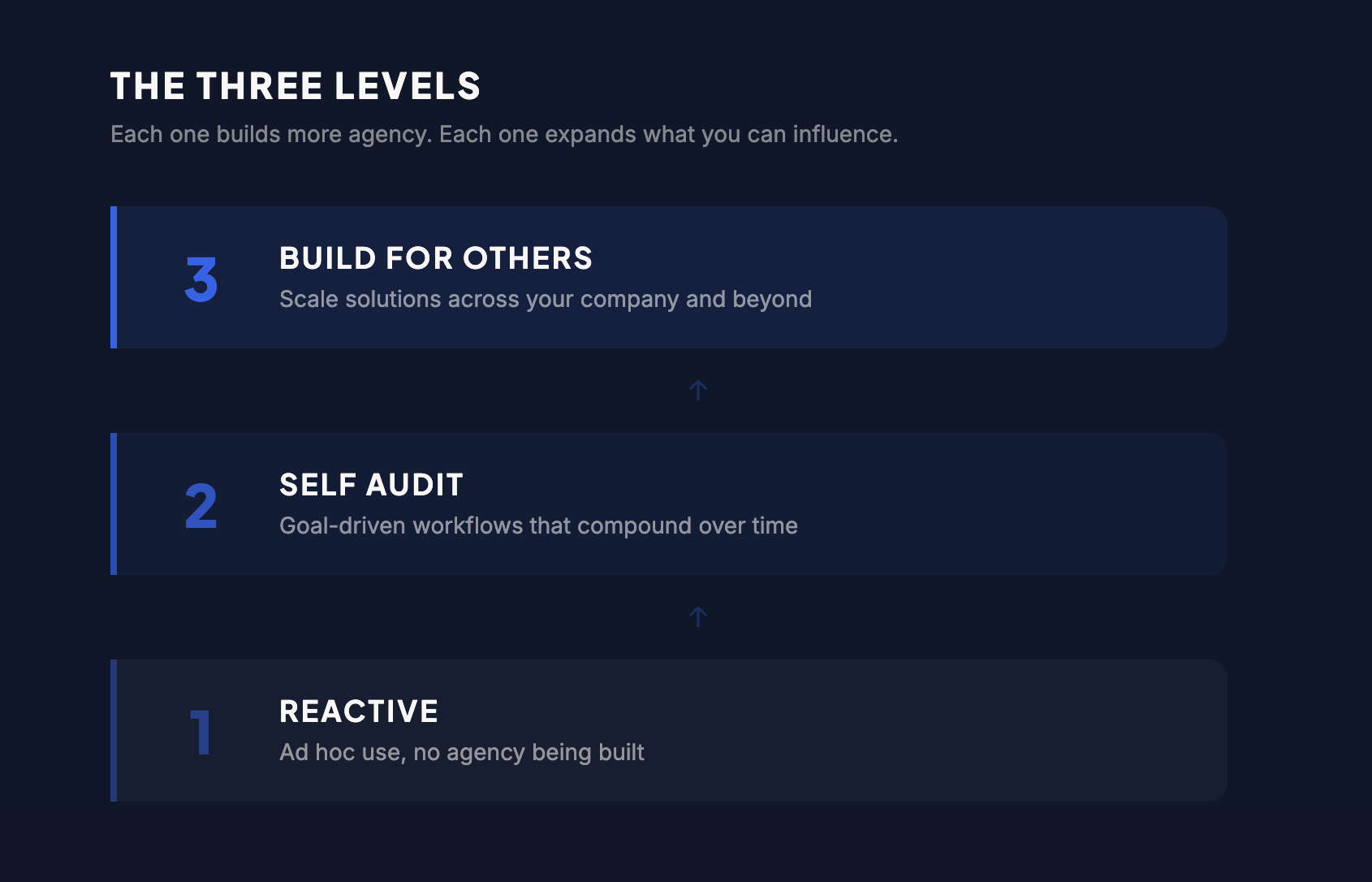 The three levels. Each one builds more agency. Each one expands what you can influence.
Level 1: Reactive
You open ChatGPT or Claude when you happen to think of it. You ask it to help draft an email, summarize a document, answer a question.
It’s useful. But it’s ad hoc.
You’re using AI the way most people used Google in 2004. Type something in, get something back, close the tab.
Most people are here.
And most people will still be here in a year. That’s the problem. Level 1 feels productive. You got an answer. You saved ten minutes. But nothing compounds. No workflow gets built. No skill develops. You’re consuming the tool, not directing it.
Level 2: The Self Audit
Level 2 is proactive. And it’s where you start developing the critical thinking muscle.
A few weeks ago I sat down on a Saturday morning and audited my entire life for repetitive computer-based tasks.
Not just work. Everything.
I called it a Self Audit. Just a blank doc and one question: what am I doing repeatedly that a computer could handle?
Personal
Meal planning was the first one I tackled.
Every Friday I’d stand in my kitchen scrolling recipe sites, cross-referencing my wife’s dietary needs, trying to remember what we’d eaten recently. Forty-five minutes before I even started cooking.
So I built an agent. It Slack messages me every Friday morning at 9am. It logs what I made last week, deep-researches recipes for our dietary needs, my wife picks the ones she wants, and it generates the grocery list. Ingredients, quantities, done.
I didn’t write code. I told Claude what I wanted, put it in plan mode, and iterated until it worked.
 My Friday morning meal planner. It deep-researches recipes for our dietary needs, my wife picks from the list, and it generates the grocery list. No code written.
That iteration is where the real learning happens. You describe your problem, the AI asks clarifying questions, and through that back-and-forth you learn what the tool can actually do.
I have eight more workflows running now. Calendar prep before meetings. Content repurposing. Research summaries. Each one saves 20 to 40 minutes a week. Added up, I got back almost a full workday.
I didn’t study prompt engineering. I just needed Friday nights to stop being annoying.
Professional
My wife had a version of this at work. She needed to pull specific columns from one spreadsheet into another. Every time, she’d do it manually. Copy, paste, check, repeat. Tedious and repetitive.
She had a clear goal: stop doing this by hand. So she started experimenting with Claude Cowork. Put it in plan mode to work through the specifics. She’s not technical. Same process I used with the meal planner.
But building the workflow isn’t where Level 2 stops. The real critical thinking shows up in how you evaluate the output.
Start with the person receiving it. If you’re building a partner brief, think about what they need to see immediately, what questions they’ll have, what’s extraneous. Tailor it before you send it.
Then get feedback from the stakeholder who needs it to succeed. They know the audience better than you do. Use their input before you ship.
Once you’ve done this a few times, codify what works. Document the patterns. Build a reusable prompt or set of guidelines (hint: Claude Skills) so the next version is better than the last without starting from scratch.
That’s how you go from someone who uses AI to someone who builds with it.
Level 3: Build for others
Level 3 is where it gets interesting. You’ve solved your own problems. You’ve started solving your team’s problems.
Now you scale that to the company and beyond.
If You Work For A Company…
Within your company, this is where the Self Audit scales to the entire org.
At Lucid, our BD team didn’t have a clean process for evaluating partnership opportunities. Status was unclear, ownership was scattered, and getting alignment with product and engineering leadership took too long.
So I built a system where every partner conversation transcript gets ingested alongside complementary research and formatted into a single source of truth.
Now our team can present every opportunity we’re evaluating for quick alignment with R&D leadership. The exec team stays current on partnership status whenever they want. We evaluate and commit to opportunities with partners faster than we ever could before.
You become the de facto AI person across your company. Leadership asks you to evaluate new tools. Directors from other departments come to you when they need to figure out how AI fits into their function.
Being that person inside your organization is a real competitive advantage right now. In two years it will be table stakes.
If You’re An Entrepreneur / Creator…
Zara Zhang built Frontend Slides, a Claude Code skill that generates HTML presentations. No traditional coding experience. She “vibe coded” the entire thing. Around 7,200 stars on GitHub.
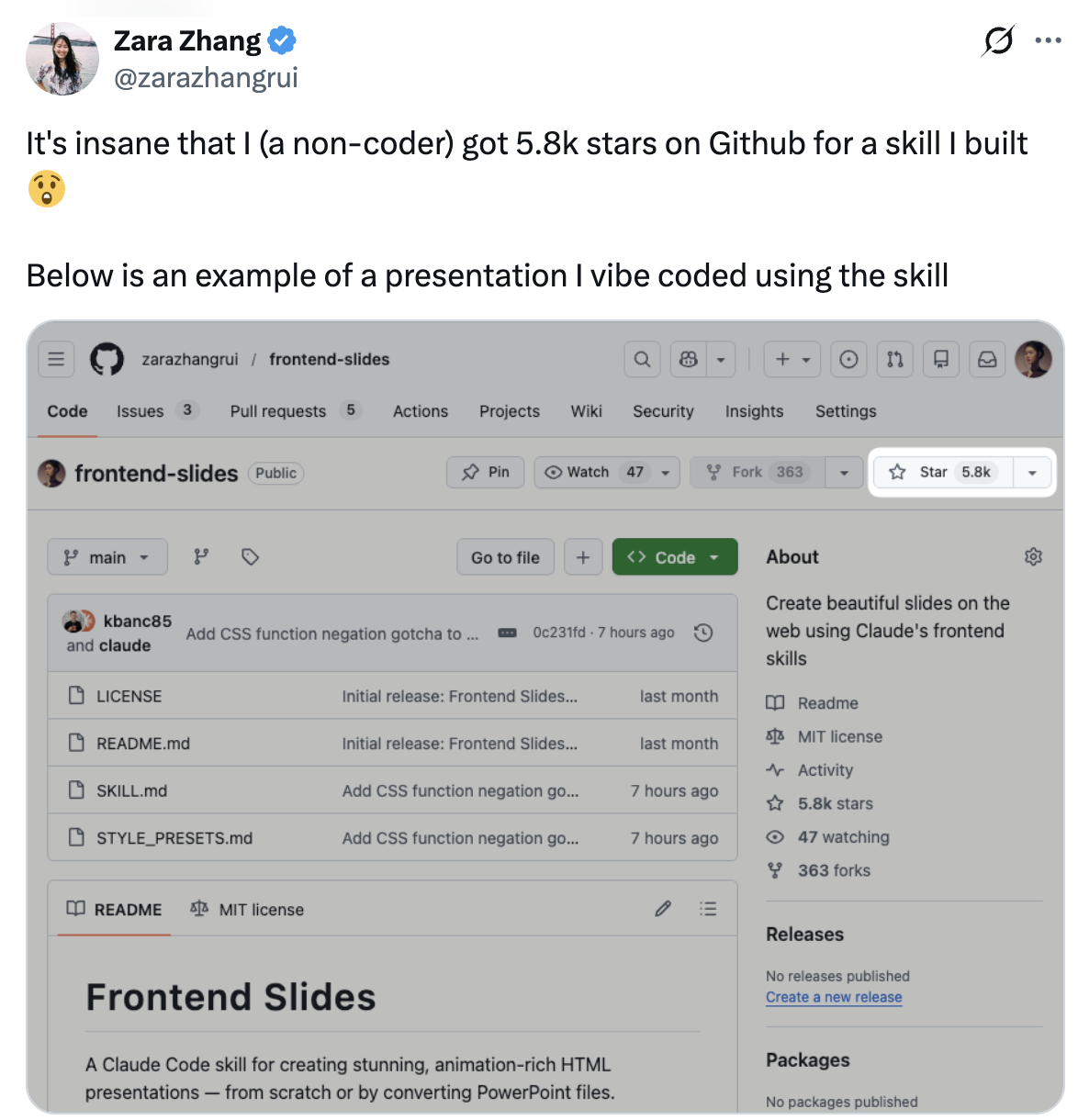 Zara Zhang built Frontend Slides with zero traditional coding experience. 5,800+ GitHub stars at the time of her post.
That’s the product path. Chris Camillo laid out the service path on a podcast.

“You can pick any business, an HVAC business, a sprinkler business. Almost none of them are willing to embrace AI right now. You can simply go to one of them and say, I’m an AI guy. Give me one area where you’re leaking money, and I’m going to fix that for you for free.”
He gave the example of a company slow to respond to after-hours calls. Leads would phone at 9 PM, get no answer, call a competitor by morning. Replicate that fix across 10 to 20 local businesses at $2,000 to $3,000 per month, and you’re at $300K to $500K a year.
Greg Isenberg put the bigger picture bluntly:
“New companies will be 1 human running autonomously with digital employees doing the work. The entrepreneur is becoming the orchestrator.”
Whether you apply it inside your company or outside it, the principle is the same. The people who deeply know how to identify and solve their own problems can easily scale their solutions to others.
Start wherever you are
The three levels are a ladder. You don’t need to jump to Level 3.
But you do need to move. The next 6 to 12 months won’t wait for you to feel ready.
If you’re at Level 1, run the Self Audit this weekend. Pick the task that annoys you most and build the workflow.
If you’re already building workflows for yourself, look at your team. What bottlenecks could you solve? That’s the move from doer to director.
If you’re already solving problems beyond your own desk, you’re ahead of almost everyone. Keep going.
Reply and tell me where you are. Level 1, 2, or 3. I read every reply, and your answers shape what I write next.
Preston
Whenever you’re ready, here are some (free) resources you can check out:
- Knowledge Base Guide — Build a personal knowledge base for better thinking and writing.
- Newsletter Prompt Playbook — AI prompts and workflows for writing weekly newsletters faster.
- Brand Voice Guide — Framework for defining and documenting your brand voice.
Get a new build-with-AI guide every week
Weekly playbooks on prompting, agents, and content systems — free.
You're in. First email lands shortly.